Diamond vs. Brilliant, What Is the Difference?
The world of precious stones and luxury jewelry comes with fascinating terminology, but people often get lost in it. The most common example is confusing two basic terms: diamond and brilliant. For a layperson, these words may sound like synonyms, but for jewelers and investors they refer to two fundamentally different things.
When you are looking for the perfect engagement ring or thinking about where to safely store your capital, understanding these terms precisely can save you a lot of money. In this guide, we will explain their properties in detail, show how pricing works and look at how investment diamonds work in practice.
What is the difference between a diamond and a brilliant?
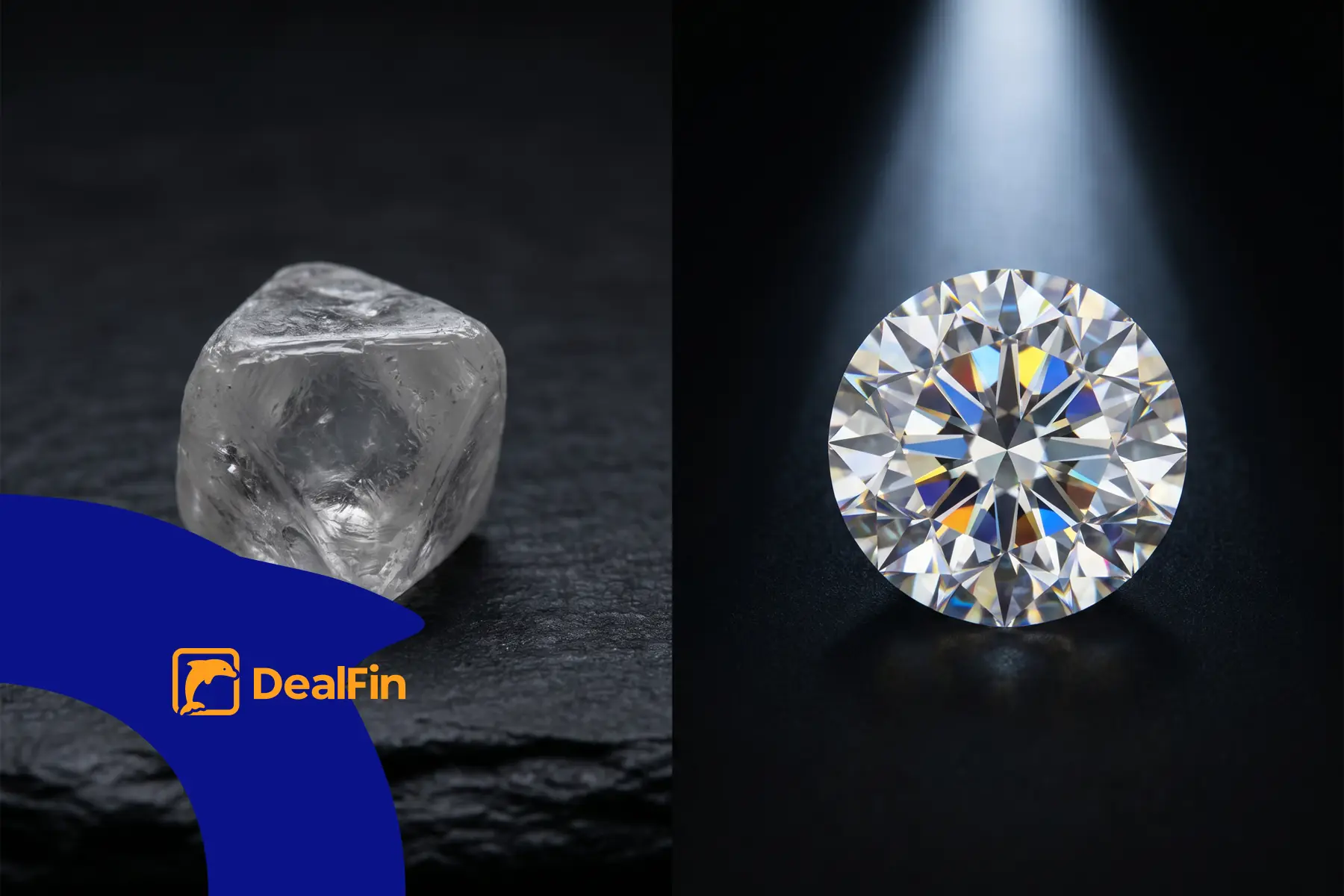
The main difference between a diamond and a brilliant is that a diamond is a raw natural mineral, while a brilliant is a diamond processed with a special round cut with at least 57 facets. Simply put, the rule is: every brilliant is originally a diamond, but not every diamond becomes a brilliant.
Diamonds are found deep underground in their raw, matte form, while a brilliant is created only later in a jewelry workshop, under the hands of an experienced cutter. It is the brilliant cut that can awaken the hidden potential of the stone and turn it into a sparkling gemstone.
Comparison table
| Criterion | Diamond | Brilliant |
| What it is | natural stone | type of cut |
| Condition | raw or cut | always cut |
| Shape | various | round with 57/58 facets |
| Price per carat | lower, raw | higher, cut |
What is a diamond?
From a chemical point of view, a diamond is the purest crystalline form of carbon. It formed deep in the Earth’s crust under extreme pressure and high temperatures over millions of years. Its most fascinating physical property is hardness. On the Mohs scale, it reaches 10/10, making it the hardest natural mineral on Earth.
The main global sources include Botswana, Russia, Canada and Australia. As for diamonds in Slovakia, you would search for them in nature in vain. However, Slovakia is an important trading hub where demand for luxury jewelry and investment commodities is steadily growing.
What is a brilliant cut?
For a raw mineral to gain its famous shine, it must go through the cutting process. At the beginning of the 20th century, mathematician Marcel Tolkowsky calculated the ideal geometric parameters for perfect light reflection inside a stone, defining the modern brilliant cut.
A classic brilliant has a round shape and consists of 57 facets, 33 on the crown and 24 on the pavilion. Sometimes a 58th facet is added at the very tip, the culet. This cut is the most popular worldwide because it maximizes the stone’s brilliance and “fire”, meaning light dispersion. Besides the brilliant cut, there are other types of cuts, princess, emerald, oval, marquise, but with these, the brilliant price and the overall complexity of processing follow different optical rules. Knowing these details directly affects the final brilliant price on the market.
The 4C rule, how diamond value is determined
The value and final diamond price are governed by a strict international standard known as the 4C rule. Each criterion has a major impact on the final amount.
4C criteria table
| Criterion | What it means |
| Carat | diamond weight, 1 ct = 0.2 g |
| Cut | quality and symmetry of cutting |
| Color | shade from colorless to yellow |
| Clarity | presence of internal inclusions |
These characteristics determine the rarity of the gemstone. When buying, always require an internationally recognized certificate from independent institutions such as GIA, IGI or HRD, which guarantee that you are buying verified diamonds.
How much do a diamond and a brilliant cost in Slovakia?
When you look at price lists, you will find that the price of diamonds is not fixed. The often-searched phrase “diamond price per gram” is a myth in jewelry, weight is measured exclusively in carats. The price also does not rise linearly. A 1-carat diamond costs significantly more than twice the price of a 0.5-carat stone with the same properties, because large pieces are rare in nature.
The 2026 price context shows stable interest in precious stones. You can buy a smaller brilliant for a ring for hundreds of euros, but top-grade investment diamonds from 1 carat require thousands to tens of thousands of euros. The figure known as brilliant price always includes a surcharge for the cutter’s work, since up to half of the original raw material weight is lost during processing.
Types of diamonds by color
Nature offers a wide palette of variants, which are divided into three main categories.
Colorless diamonds
These are classic and the most widespread. Their quality is measured on a scale from D, completely colorless and the most valuable, to Z, with a yellowish tint.
Black diamond
Known as Carbonado. These stones show high light absorption, are opaque and have a distinctive dark appearance. They are very popular in modern jewelry. The black diamond price is usually lower than that of clear stones, because it contains many graphite impurities.
Colored diamonds, fancy
Pink, blue, yellow or green gemstones are astronomically rare. They make up only a fraction of global mining and reach record prices at auctions.
If you are considering setting a brilliant into jewelry, the ideal material is white gold, which does not distort the color of the stone. You can learn more in our article “White Gold, Hallmark, Price and Everything About It”.
Natural vs. synthetic diamond
Modern technology has brought laboratory-created diamonds, Lab-Grown, produced using HPHT or CVD methods. They have the same chemical composition, structure and hardness as natural stones.
The only difference is origin and price. The synthetic diamond price is 30–70% lower. You cannot tell them apart with the naked eye, it requires professional gemological equipment. While they are a great choice for jewelry, they do not have long-term value for investors due to unlimited production.
Investment diamonds, is it worth it?
If you are looking for an alternative for asset diversification, investment diamonds are an interesting option. For this purpose, loose stones with top certificates are used, not jewelry.
Advantages:
- High value in a small size, asset mobility
- Durability and indestructibility
- Global market
Disadvantages:
- No single exchange price
- Low liquidity compared to gold
- High dealer margins
Thinking about where to store your savings? Read our article “Investing in Gold for Beginners” and compare the stability of precious metals with diamonds. If you are looking for a stable investment diamond, buy only from verified sellers who have long covered diamonds in Slovakia.
How to recognize a real diamond?
There are imitations on the market, such as cubic zirconia or moissanite. Simple home tests can help:
- Breath test: A real diamond conducts heat very well, so it does not fog up. Cubic zirconia will stay fogged for a short while.
- Water test: Thanks to its high density, a real diamond immediately sinks to the bottom of a glass of water.
- Loupe test: Under 10x magnification, you will see perfectly sharp cut edges, while imitations become rounded and scratched over time.
For maintaining finished jewelry with gemstones, our guide “Cleaning Gold at Home” can help. However, 100% certainty of a stone’s authenticity can only be provided by a certificate and professional gemology.
FAQ, Diamond vs. Brilliant
A diamond is a raw natural mineral. A brilliant is a diamond processed with a special round cut with 57 or 58 facets.
The price for 1 carat, 0.2 g, in 2026 starts at around €4,000 for average quality and exceeds €15,000 for top parameters.
Among classic stones, the most expensive are completely colorless diamonds, category D. The absolute top are extremely rare natural colored, fancy, diamonds, especially red and blue.
Diamonds concentrate enormous wealth into minimal size. Gold, however, has the advantage of higher liquidity and a clearly defined global exchange price.
A diamond does not wear down and does not fog up during the breath test. Cubic zirconia gets scratched over time and remains fogged for a short while in the air.
It is a natural form of carbon, Carbonado, with a high content of dark inclusions. It does not reflect light, but absorbs it, which gives it its specific color.
Looking for a stable investment in durable assets?
The world of precious stones and rare metals offers great opportunities to protect wealth from inflation. Explore our other educational finance articles and learn more about safe capital appreciation directly on DealFin.sk.