White Gold, Hallmark, Price and Everything About It
The taste of the Slovak public has gone through a quiet revolution over the past two decades. While our parents’ generation swore by traditional, distinctly coloured yellow gold, modern jewellery stores today are visually dominated by a captivating cool shine. It has become the clear choice for young couples looking for wedding rings, as well as for people who want to wear precious metals without their jewellery looking too flashy. Yet even though we see it every day on thousands of hands, few people know its real story.
This metal is not found in nature, there is no mine where it can be extracted. Every single ring or necklace is the result of sophisticated alchemy. If you are considering buying a new family jewel, the following lines for 2026 will help you uncover the hidden composition of this material, decode Slovak hallmark marks, understand its pricing and reveal the truth behind the most common myths surrounding it.
What Is White Gold?
From a metallurgical point of view, it is a refined alloy in which pure yellow gold plays the main role, but its natural colour is suppressed by the addition of light-coloured metals. Pure gold itself is too soft, so in jewellery making, no piece can do without added metals.
By adding the right elements, the material gains not only high durability but also a different appearance. The real secret behind the final mirror-like shine, however, is surface rhodium plating. Without this microscopic layer of rare metal, the material would naturally have a matte, muted greyish or slightly straw-like tone.
What Is White Gold Made From?
The process of changing the colour depends on the exact ratio of alloying elements. In the past, jewellers often used nickel, which gave the mixture hardness. However, due to strict health regulations, the European Union has radically restricted the use of nickel, as it is a common skin allergen.
Today, high-end jewellery relies on hypoallergenic compositions dominated by silver, zinc and, above all, rare palladium. Palladium is the element that most effectively removes yellow tones. Once the jewellery is finished, it goes through a galvanic bath, where rhodium is applied to the surface. This gives the metal an uncompromising white glow and protects it from small impacts.
White Gold Hallmark Marks in Slovakia
When investing in precious metals, the best proof of quality is the white gold hallmark. Every legal piece of jewellery must pass inspection by the Slovak Assay Office, which stamps it with an official mark guaranteeing the purity of the alloy.
| Metal purity | Carats | Share of pure gold | Typical use in Slovakia |
| 999 | 24 ct | 99,9 % | investment bars and coins |
| 750 | 18 ct | 75,0 % | premium jewellery and complex watches |
| 585 | 14 ct | 58,5 % | domestic standard, best-selling jewellery |
| 375 | 9 ct | 37,5 % | commercial, low-purity products |
The Slovak market has long preferred a purity of 585/1000. If you are holding a more massive piece in your hand, the official white gold hallmark gives you complete certainty that more than half of its weight consists of pure precious metal.
Beware of a common myth: online, the strange phrase white gold hallmark 925 appears very often. Here we must be strict: the 925 hallmark does not belong to gold, but to silver. If someone tries to sell you a ring claiming it is white gold with a 925 hallmark, it is silver. A real white gold hallmark always has the values 585 or 750.
How Much Does White Gold Cost?
If you compare two visually identical pieces of jewellery, you will often find that the price of white gold is slightly higher than the price of the classic yellow version. Why is that the case when the content of pure gold is the same?
The answer lies in the cost of the added metals and processing. While ordinary elements are added to yellow gold, white alloys use palladium, whose price on global markets can sometimes even exceed gold itself. When you add the cost of final rhodium plating, the resulting white gold price in Slovakia logically includes this technological premium.
White Gold vs. Platinum, What Is the Difference?
People confuse these two materials most often, although they are connected only by a similar silvery colour. Platinum is a separate, chemically pure element. Unlike modified gold, it is naturally white, so it does not need any rhodium treatment and never changes its colour.
If you compare a white gold ring with a platinum ring of the same size, the platinum one will feel much heavier in your hand, because platinum has a significantly higher density. It is almost eternal, extremely resistant to wear and completely hypoallergenic. The price is the trade-off for these perfect properties: because of its high purity and demanding processing, you will pay much more for platinum.
White Gold vs. Silver, How to Tell Them Apart?
At first glance, they look like twins, but in terms of value and durability, there is a huge gap between them. How can you identify them reliably?
Gold treated with rhodium gives off a sharp, cool reflection with high shine, while silver has a slightly more muted tone. Silver is also chemically unstable: when it comes into contact with cosmetics, it begins to oxidise and darken. Gold keeps its stable integrity. The fastest test is weight, silver is lighter, and a look at the hallmarks, where silver 925 stands against gold 585.
White Gold in Jewellery Making in Slovakia
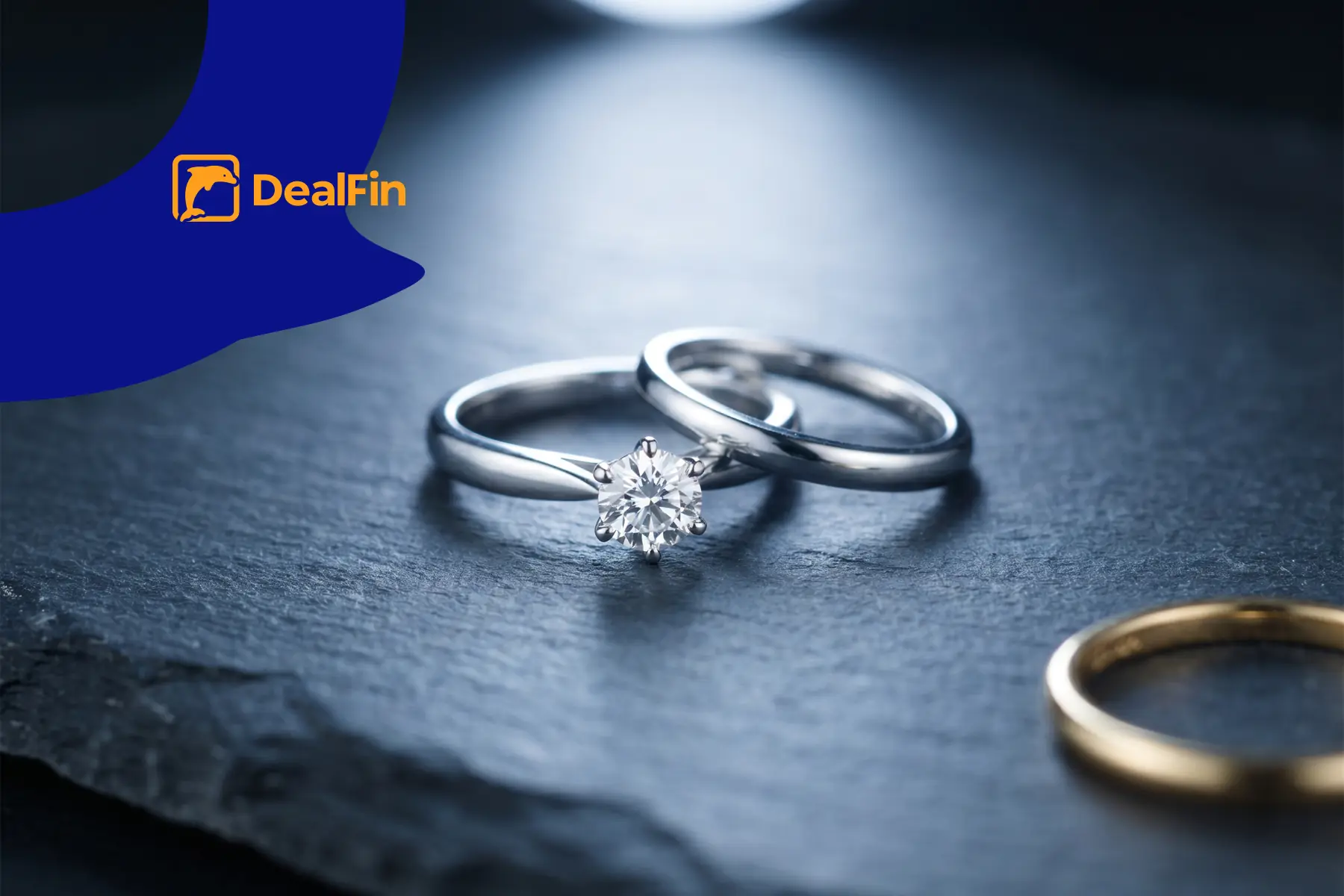
This metal has become the uncrowned king of the wedding industry. Modern white gold rings have pushed traditional yellow wedding bands to the sidelines. The reason is simple: a neutral white base allows the clarity of precious stones to stand out fully, multiplying their brightness. We write more about this phenomenon in the article “Diamond vs. Brilliant”.
Jewellers in Slovakia are now experiencing a boom in combined design, white and yellow gold wedding bands are the ideal compromise for couples. Whether you are looking for a delicate white gold pendant, more substantial women’s white gold rings, hanging earrings, white gold charms or modern white gold jewellery, this material gives every design a touch of urban elegance.
How to Care for White Gold?
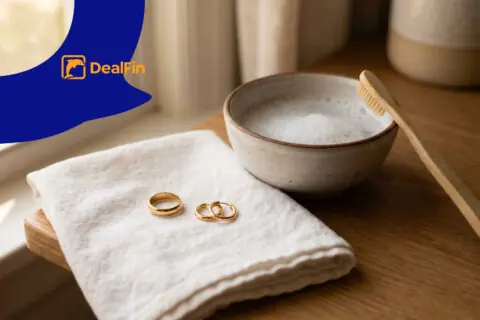
To keep jewellery pieces their mirror-like appearance, they require a specific approach. Since their surface is protected by rhodium, home care must be as gentle as possible. A microfibre cloth and lukewarm water with a drop of dish soap are enough. We explain the full process in the article “Cleaning Gold at Home”.
Remember that rhodium is not eternal. With daily wear, this layer slowly rubs off. After 2 to 5 years, you may notice that a white gold ring develops a slight yellowish tone. This is not a defect. Just visit a jewellery workshop, where they will galvanically re-plate the piece, and you will leave with jewellery that looks visually new again.
FAQ, White Gold
It is an alloy of yellow gold and light-coloured metals, palladium and silver. It gets its silvery shine through surface plating with rare rhodium.
The most common jewellery in Slovakia carries the 585 hallmark, 14 carats. More exclusive designer pieces use the 750 hallmark, 18 carats.
The price fluctuates based on the global exchange. In 2026, the price of pure metal before processing ranges roughly from 45 to 75 euros per gram.
Yes, jewellery made from it is often more expensive because of the presence of palladium in the alloy and the technological costs of rhodium plating.
Gold is a modified alloy that requires rhodium renewal. Platinum is a naturally white, significantly heavier and chemically more resistant metal with a higher price tag.
No. The 925 hallmark belongs to silver. Gold with this marking does not exist on the market.
The reason is wear of the surface rhodium layer, under which the original, slightly yellowish metal mixture begins to show.
Are You Also Interested in Gold as a Stable Investment?
While jewellery is subject to fashion, pure gold in the form of bars works as protection against inflation. If you want to diversify your assets, read our guide “Investing in Gold for Beginners”. Complete market coverage is available directly on the DealFin.sk portal.